Today, I explain something I say on various Social Media.
Monday, March 10, 2014
Wednesday, March 5, 2014
Strider Returns With Razor Sharp Precision
Capcom has been attempting to mend fences with jaded fans over the last six months. First there was the release of the superb DuckTales: Remastered, which was for my money, one of the best games released in 2013. Then there was an announcement that Hiryu would once again battle Grandmaster Meio in an all new Strider game. Some skeptics wondered if a Strider game, with it's generally linear gameplay, had a place in 2014. There was also trepidation when it was discovered that Double Helix would be handling development. For the uninitiated, Double Helix has made some pretty mediocre games, so it's was a valid concern. Thankfully, on February 18th, Strider put all concerns to rest. Double Helix has done an amazing job of capturing the spirit of what made Strider a bonafide classic for Capcom and Strider 2 a legitimate cult classic and certifiable hidden gem for the PS1.
Story wise, this Strider is essentially a retelling of the story in the Arcade title. The Striders are a group of elite ninja-like operatives who specialize in all manner of wetwork. Their youngest member, Hiryu, is the youngest Strider to reach "A-Rank"or elite status among the group. Hiryu is given the task of infiltrating Kazakh City and assassinating a tyrannical despot, Grandmaster Meio. Kazakh City is broken into several main sectors: Kazakh City, Military Ring, Underground, Research Facility, and Tower, and these main sectors contain several smaller areas. This vast game world is tied together in an industrial web of sorts, with gamers being able to bounce back and forth between areas pretty easily as long as you have the item to access a particular door.

Another main difference in this iteration of Strider that sets it apart from others is the addition of a variety of augments for Hiryu's sword, the "Cypher", Projectile weapons, and the return of Hiryu's robotic helpers. All of these weapon enhancements also serve a secondary function that allows Hiryu to traverse the vastness of Kazakh City with ease and access the numerous bonus items. Classic bosses from the original Strider game like the Armored Dragon, Solo, Mecha Pon, and others return in a major way to attempt to thwart Hiryu. There's also a lot of other little bits of nostalgia sprinkled in with unlockable character art, remixed versions of tracks from the NES and Arcade soundtracks. Strider is definitely as much about paying respect to the past as it is about drawing in new players.
All in all, Strider is a testament to the right property being the perfect fit for a developer to truly resurrecting their reputation. Double Helix took a franchise that many younger gamers know very little about and with a major degree of TLC, made it one of the better titles Capcom has put their names on in a few years. Here's to hoping Capcom has returned to form and won't just drift back into old habits of constantly rehashing Street Fighter and Resident Evil titles on a near yearly basis. Hiryu's latest mission is a marvel of great gaming, and definitely worth the $15 price tag if not more.
Now, for me to get this petition for a Legendary Wings sequel or remake going. Capcom, make it happen.
Story wise, this Strider is essentially a retelling of the story in the Arcade title. The Striders are a group of elite ninja-like operatives who specialize in all manner of wetwork. Their youngest member, Hiryu, is the youngest Strider to reach "A-Rank"or elite status among the group. Hiryu is given the task of infiltrating Kazakh City and assassinating a tyrannical despot, Grandmaster Meio. Kazakh City is broken into several main sectors: Kazakh City, Military Ring, Underground, Research Facility, and Tower, and these main sectors contain several smaller areas. This vast game world is tied together in an industrial web of sorts, with gamers being able to bounce back and forth between areas pretty easily as long as you have the item to access a particular door.

Another main difference in this iteration of Strider that sets it apart from others is the addition of a variety of augments for Hiryu's sword, the "Cypher", Projectile weapons, and the return of Hiryu's robotic helpers. All of these weapon enhancements also serve a secondary function that allows Hiryu to traverse the vastness of Kazakh City with ease and access the numerous bonus items. Classic bosses from the original Strider game like the Armored Dragon, Solo, Mecha Pon, and others return in a major way to attempt to thwart Hiryu. There's also a lot of other little bits of nostalgia sprinkled in with unlockable character art, remixed versions of tracks from the NES and Arcade soundtracks. Strider is definitely as much about paying respect to the past as it is about drawing in new players.
All in all, Strider is a testament to the right property being the perfect fit for a developer to truly resurrecting their reputation. Double Helix took a franchise that many younger gamers know very little about and with a major degree of TLC, made it one of the better titles Capcom has put their names on in a few years. Here's to hoping Capcom has returned to form and won't just drift back into old habits of constantly rehashing Street Fighter and Resident Evil titles on a near yearly basis. Hiryu's latest mission is a marvel of great gaming, and definitely worth the $15 price tag if not more.
Now, for me to get this petition for a Legendary Wings sequel or remake going. Capcom, make it happen.
Labels:
2014,
Capcom,
Double Helix,
Grandmaster Meio,
Hiryu,
PSN,
Steam,
Strider,
Xbox Live
Tuesday, February 25, 2014
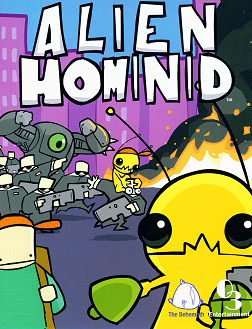
Alien Hominid Hit Consoles A Decade Ago, And Changed Everything.
The early 2000s were a very cool time for the Internet. Sites that showcased flash based videos and games were really popular, and the most popular of those was Newgrounds. None of those has been as popular as a little homage to Contra and Metal Slug from a small team known as The Behemoth. When this game hit the site, it became wildly successful, so much so, that it was tapped as the team's first console release. That game was one of the most popular titles on Xbox Live Arcade for a time and is still one of the great gems released on the PS2 and GameCube. This game, Alien Hominid is still available in it's original form as a flash game, and after a decade, the console versions of the title hold up incredibly well to this day.
For those unfamiliar with this title, players take control of a little yellow alien who is simply trying to find his shtp and leave home after being shot down by the FBI. The little guy is armed with a simple blaster that also has a charge shot much like Mega Man's eponymous Mega Buster. There are also a number of weapons powerups and vehicular weapons that pop up during the game. All of the weapons are par for the course with side scrolling action games, but that's the charm of Alien Hominid. It doesn't need to do anything new or innovative, but it does everything well. Boss fights are a throwback to the days of Contra: big bosses that fight in patterns and die in huge explosions.
Graphically, it's a vibrant, colorful game in general. Not having voices doesn't distract from the characters in Alien Hominid bursting with personality. Even the little rats in a sewer stage are smarter than many main characters in big budget titles with a huge fanbase. Animation wise, it isn't particularly fluid, but it's definitely serviceable, and while parts of the soundtrack seem way too serious for the backdrop, it's pretty solid nonetheless.
Apart from the core game, there are a few interesting minigames that proved pretty awesome. There is a pretty solid challenge mode with different parameters, and play options. Also, a host of "PDA Games" which was a series of single screen platform jumping levels with puzzle elements and a level editor. Finally, there was Super Soviet Missile Mastar, an Atari 2600 flavored scrolling "avoid the obstacles and hit the target" with a Soviet invasion of America theme. None of them are incredibly deep, but they are definitely fun distractions from the core game.
Alien Hominid was born in 2002, hit consoles in 2004, and cemented The Behemoth as a pretty big deal among indy developers. They have grown to make some pretty amazing things happen and it all started with this game. Here's to celebrating the console release of one of gaming's most unlikely success story.
For those unfamiliar with this title, players take control of a little yellow alien who is simply trying to find his shtp and leave home after being shot down by the FBI. The little guy is armed with a simple blaster that also has a charge shot much like Mega Man's eponymous Mega Buster. There are also a number of weapons powerups and vehicular weapons that pop up during the game. All of the weapons are par for the course with side scrolling action games, but that's the charm of Alien Hominid. It doesn't need to do anything new or innovative, but it does everything well. Boss fights are a throwback to the days of Contra: big bosses that fight in patterns and die in huge explosions.
Graphically, it's a vibrant, colorful game in general. Not having voices doesn't distract from the characters in Alien Hominid bursting with personality. Even the little rats in a sewer stage are smarter than many main characters in big budget titles with a huge fanbase. Animation wise, it isn't particularly fluid, but it's definitely serviceable, and while parts of the soundtrack seem way too serious for the backdrop, it's pretty solid nonetheless.
Apart from the core game, there are a few interesting minigames that proved pretty awesome. There is a pretty solid challenge mode with different parameters, and play options. Also, a host of "PDA Games" which was a series of single screen platform jumping levels with puzzle elements and a level editor. Finally, there was Super Soviet Missile Mastar, an Atari 2600 flavored scrolling "avoid the obstacles and hit the target" with a Soviet invasion of America theme. None of them are incredibly deep, but they are definitely fun distractions from the core game.
Alien Hominid was born in 2002, hit consoles in 2004, and cemented The Behemoth as a pretty big deal among indy developers. They have grown to make some pretty amazing things happen and it all started with this game. Here's to celebrating the console release of one of gaming's most unlikely success story.
Labels:
10th Anniversary,
Alien Hominid,
Gamecube,
Newgrounds,
PS2,
The Behemoth
Sunday, February 23, 2014
Twitch Plays Pokemon Or Finding Chaos In Order
I discovered something today that has apparently been going on for nearly 11 days on streaming site Twitch.tv. This amazing event involves the ever fluctuating number of players watching the stream and an emulation of Pokemon Red. This particular emulation is amazing in that everyone signed into the community chat can have a hand in controlling the action onscreen. With so many players essentially fighting for the same controller at the same time, there is definitely more potential for chaos than order. There are groups of people both attempting to honestly play the game together with a hive mentality, while there are those looking to bring down the entire thing by trying to "break the system". It's a remarkable social experiment, and it proves how polarized factions of our population really are. If you want to be a part of the chaotic fun, you can join in at Twitch Plays Pokemon.
Wednesday, February 19, 2014
Tuesday, February 18, 2014
Paperboy Is 30. Do You Feel Old Yet?
Today's video takes a look at Paperboy, a beloved title from Atari as it celebrates it's 30th anniversary.
Sunday, February 9, 2014
Goodbye Flappy Bird
Today's video discusses the early demise of Flappy Bird, which may have been killed off because of gamer complaints.
Subscribe to:
Posts (Atom)